Over the past week, leaders from some of the world’s largest AI companies, including OpenAI, Anthropic, Microsoft AI, and Google DeepMind, joined scientists, biotechnology leaders, and national security experts in calling for mandatory DNA synthesis screening.
For many people, this may seem like a new discussion driven by advances in artificial intelligence. In reality, DNA synthesis screening is increasingly being viewed as one of the key safeguards for ensuring that advances in artificial intelligence and synthetic biology continue to benefit society while reducing opportunities for misuse.
What’s striking to me is not that we’re having this conversation; it’s how quickly it has moved from industry working groups and biosecurity discussions to the front pages of major news outlets.
The DNA synthesis industry, biosecurity organizations, and policymakers have been discussing sequence screening, customer verification, and governance frameworks for years.
When I first became involved in these discussions, they were largely taking place among DNA synthesis providers, biosecurity organizations, policymakers, and a relatively small group of industry experts.
Today, AI companies are part of the conversation.
That shift alone tells you how much the landscape has changed.
The DNA synthesis industry has a long history of voluntary screening efforts and industry-led discussions around responsible use. Many of the concepts being discussed today are extensions of work that has been underway for years.
What AI has done is increase the urgency and visibility of those efforts.
What has changed is the emergence of increasingly capable AI systems and the attention they have brought to the topic.
As someone who has spent more than two decades in the oligonucleotide synthesis industry, I find the current discussion both important and overdue.
Why DNA Synthesis Screening Exists
DNA synthesis has become a foundational technology for modern life science research. Researchers use synthetic DNA every day to develop diagnostics, therapeutics, vaccines, agricultural products, and countless other biotechnology applications.
The ability to order custom DNA has accelerated scientific discovery and enabled advances that would have been difficult or impossible just a few decades ago.
At the same time, DNA synthesis providers have long recognized that access to synthetic DNA comes with responsibilities.
Many providers voluntarily screen customer orders and submitted sequences to identify potentially dangerous pathogens, toxins, or other sequences that may warrant additional review. These screening practices help ensure that synthetic DNA remains accessible for legitimate research while reducing the risk of misuse.
The recent proposal would make these types of safeguards mandatory across the industry.
What AI Changes
Artificial intelligence has the potential to become one of the most powerful tools ever developed for scientific research.
AI systems are already helping researchers analyze proteins, interpret biological data, design experiments, and accelerate scientific discovery. The potential benefits are enormous.
However, the same tools that make legitimate researchers more productive could also lower barriers to biological design for individuals who may not have had access to that knowledge in the past.
This is why many AI leaders are now advocating for stronger DNA synthesis safeguards.
The concern is not that AI creates biological risk on its own. The concern is that AI may accelerate access to biological knowledge faster than existing oversight mechanisms evolve.
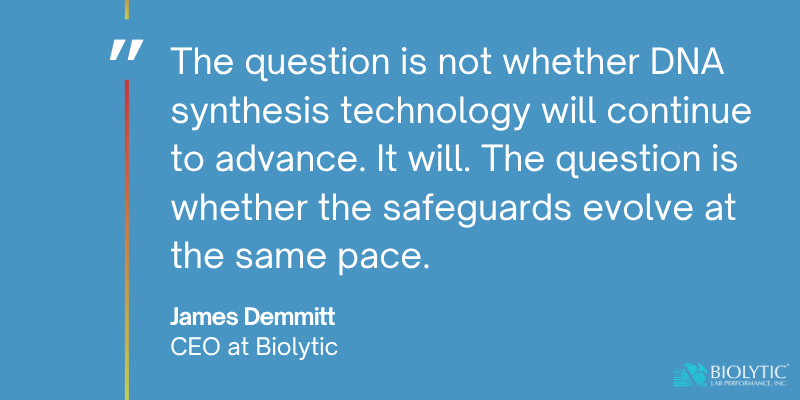
The question is not whether DNA synthesis technology will continue to advance. It will. The question is whether the safeguards evolve at the same pace.
This Is Bigger Than DNA Providers
Much of the current discussion focuses on DNA synthesis providers, but the reality is that biotechnology is an ecosystem.
Researchers, synthesis providers, instrument manufacturers, software developers, reagent suppliers, universities, regulators, and policymakers all play a role.
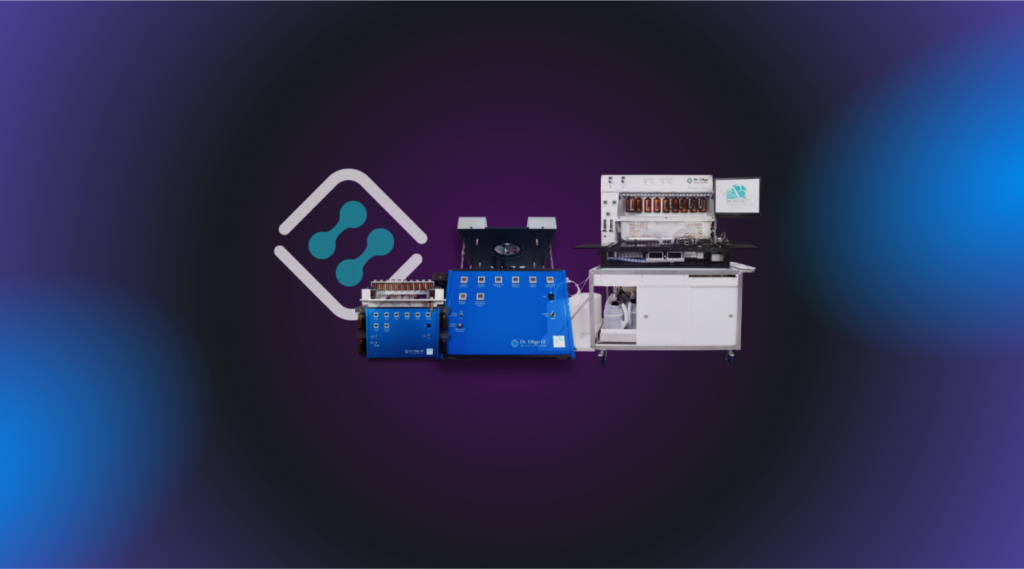
As a manufacturer of oligonucleotide synthesis systems, Biolytic views this discussion through a slightly different lens.
Our mission has always been to make DNA and RNA synthesis more accessible, reliable, and scalable for researchers around the world. Advances in automation continue to improve productivity, reduce barriers to entry, and enable new scientific discoveries.
Those advances are overwhelmingly positive.
At the same time, any technology that becomes more powerful and more accessible requires thoughtful consideration of how it is used.
Why This Topic Is Personal
Several years ago, I participated in the Nuclear Threat Initiative’s report, Benchtop DNA Synthesis Devices: Capabilities, Biosecurity Implications, and Governance.
The report examined how increasingly accessible DNA synthesis technologies could impact biosecurity and explored approaches for balancing innovation with responsible oversight.
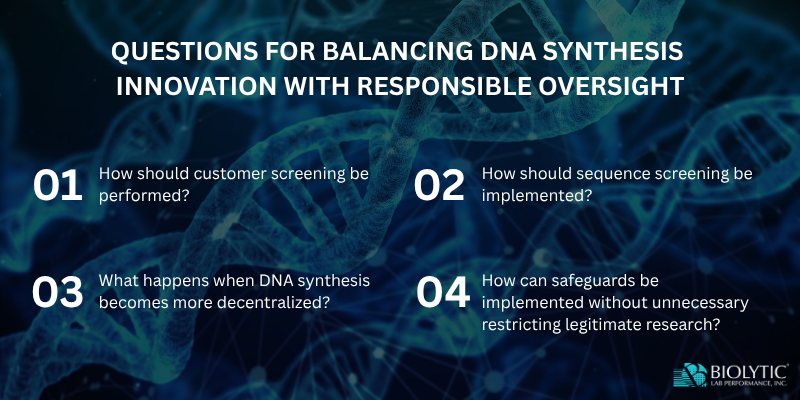
Many of the questions being discussed today were already being examined at that time:
- How should customer screening be performed?
- How should sequence screening be implemented?
- What happens when DNA synthesis becomes more decentralized?
- How can safeguards be implemented without unnecessarily restricting legitimate research?
The recent calls from AI leaders reinforce many of those same themes.
What I find particularly interesting is how closely the current discussion mirrors questions that were being asked several years ago regarding benchtop DNA synthesis technologies.
The technology continues to evolve, but the fundamental challenge remains the same: how do we maximize the benefits of increasingly accessible synthesis technologies while maintaining practical safeguards that reduce opportunities for misuse?
That question was relevant then, and it remains relevant today.
More recently, I was also interviewed by Nature regarding the intersection of AI, biosecurity, and DNA synthesis. What struck me most was how quickly the conversation has evolved. Topics that were once discussed primarily among industry experts and biosecurity professionals are now being debated by AI companies, policymakers, and the broader scientific community.
That shift alone demonstrates how important this issue has become.
My View
I believe scientific innovation and biosecurity are not competing goals.
The life sciences have delivered extraordinary benefits to society, and DNA synthesis has played an important role in many of those advances. Continued innovation will be essential for addressing future challenges in healthcare, agriculture, and biotechnology.
At the same time, responsible innovation requires responsible safeguards.
The goal should not be to slow scientific progress.
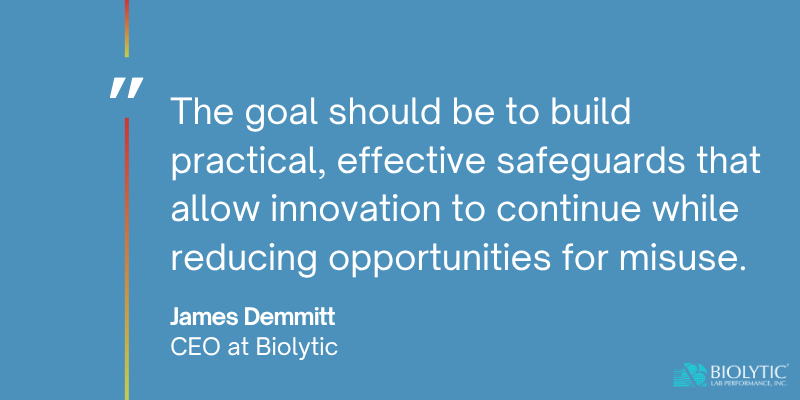
The goal should be to build practical, effective safeguards that allow innovation to continue while reducing opportunities for misuse.
That has been the objective of DNA synthesis screening efforts for years, and it remains just as important today.
The recent attention from AI leaders has brought renewed visibility to these discussions.
The underlying challenge remains the same: ensuring that advances in biotechnology and artificial intelligence continue to benefit society while minimizing risk.
That is a challenge worth solving.
Further Reading
Open Letter: In Support of Mandatory Nucleic Acid Synthesis Screening and Recordkeeping
https://www.thefai.org/posts/in-support-of-mandatory-nucleic-acid-synthesis-screening-and-recordkeeping
SecureDNA Initiative
An Open Letter in Support of Mandatory Nucleic Acid Synthesis Screening and Recordkeeping
Microsoft: Strengthening Biosecurity in the Era of AI
Strengthening biosecurity in the era of AI
NTI Report: Benchtop DNA Synthesis Devices: Capabilities, Biosecurity Implications, and Governance
https://www.nti.org/wp-content/uploads/2023/05/NTIBIO_Benchtop-DNA-Report_FINAL.pdf
Nature: AI, Biosecurity, and the Future of DNA Synthesis
Biothreat hunters catch dangerous DNA before it gets made
Biolytic: CEO James Demmitt Featured in Nature Article on AI, Biosecurity, and the Future of DNA Synthesis
https://blog.biolytic.com/2025/10/14/biolytic-ceo-james-demmitt-featured-in-nature-article-on-ai-biosecurity-and-the-future-of-dna-synthesis/
WIRED: OpenAI and Anthropic Sign Letter Calling for DNA Synthesis Safeguards
OpenAI and Anthropic Sign Letter to Prevent AI-Developed Biological Weapons
STAT News: AI Titans Push Congress Toward DNA Synthesis Safeguards
OpenAI, Anthropic, Inceptive Nucleics, Grail: Readout Newsletter
About the Author
James Demmitt is CEO of Biolytic Lab Performance, Inc., a manufacturer of automated oligonucleotide synthesis and post-synthesis processing systems. He has participated in industry discussions surrounding DNA synthesis governance, biosecurity, and emerging synthesis technologies, including the Nuclear Threat Initiative’s report on benchtop DNA synthesis devices. James was also featured in Nature discussing the intersection of artificial intelligence, biosecurity, and DNA synthesis.